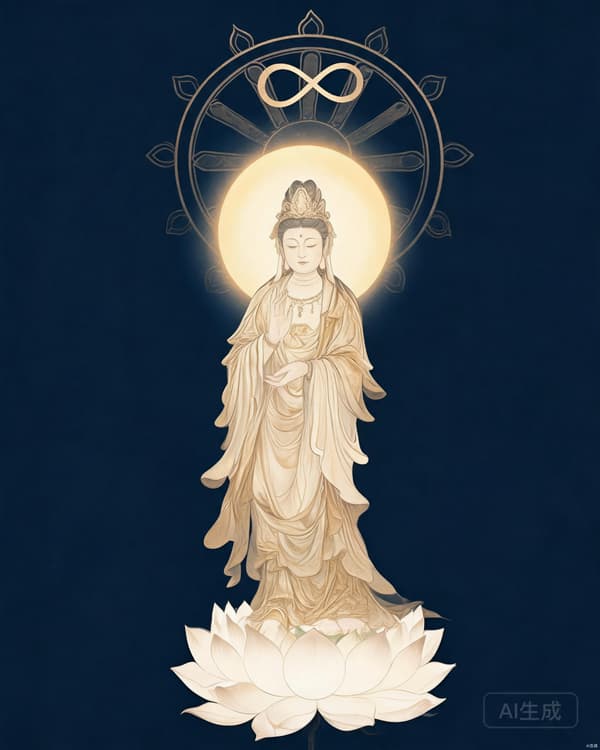
Overview
Origin
Ancient India
Founded period
Ancient world
Important figures
Shantideva · Thich Nhat Hanh: Philosophy, Mindfulness & Legacy
Major texts
Heart Sutra · Diamond Sutra: Emptiness & Buddhist Wisdom · Lotus Sutra: The Buddha''s Universal Teaching
Concept archive
Core Principles
PRINCIPLE 01
bodhisattva ideal
PRINCIPLE 02
emptiness
PRINCIPLE 03
compassion
PRINCIPLE 04
Buddha-nature
PRINCIPLE 05
non-duality
People in this tradition
Important Figures
Shantideva
A historically careful introduction to Shantideva, the Indian Mahayana Buddhist philosopher and author of the Bodhicaryavatara on the bodhisattva path and compassion.
Thich Nhat Hanh: Philosophy, Mindfulness & Legacy
An accessible introduction to Thich Nhat Hanh, the Vietnamese Zen master who brought mindfulness and engaged Buddhism to a global audience.
Primary and related texts
Related Books
Heart Sutra
An introduction to the Heart Sutra, a celebrated Mahayana Buddhist text on emptiness, and its philosophical and devotional significance.
Diamond Sutra: Emptiness & Buddhist Wisdom
An introduction to the Diamond Sutra, a beloved Mahayana Buddhist text on emptiness and the practice of wisdom, and its philosophical significance.
Lotus Sutra: The Buddha''s Universal Teaching
An introduction to the Lotus Sutra, a foundational Mahayana Buddhist text on the Buddha's universal teaching, skillful means, and the potential of all beings to awaken.
Quotation archive
Quote Perspectives
“All phenomena are preceded by the mind. The mind is their master; they are produced by the mind. If one speaks or acts with a corrupted mind, suffering follows, as the wheel of the cart follows the ox's hoof.”
“Hatred is never appeased by hatred in this world. By non-hatred alone is hatred appeased. This is an ancient law.”
“There is no fire like passion. There is no grip like anger. There is no net like delusion. There is no river like craving.”
“As rain leaks into an ill-thatched house, so passion enters an uncultivated mind. As rain does not leak into a well-thatched house, so passion does not enter a cultivated mind.”
“You yourselves must make the effort. The Buddhas are only teachers. Those who enter this path and practice meditation are freed from Mara's bonds.”
“All conditioned dharmas are like a dream, an illusion, a bubble, a shadow, like dew, like a flash of lightning — and should be viewed as such.”
“Form is emptiness, emptiness is form. Form is no other than emptiness, emptiness is no other than form. The same is true of feelings, perceptions, mental formations, and consciousness.”
“The rain from a single cloud falls in a single stream, yet each plant and tree, each herb and shrub, receives its own measure of water and grows.”
Overview
Mahayana Buddhism is one of the major historical and doctrinal formations of Buddhist tradition, emerging in India and later flourishing across Central and East Asia. The term Mahayana (“great vehicle”) was used by its proponents to distinguish a path centered on the liberation of all beings from earlier models that appeared to focus on individual liberation. Rather than a single unified school, Mahayana names a family of traditions, texts, and philosophical positions that developed over many centuries.
Historical Development
Mahayana movements first became visible in India around the early centuries of the common era, emerging alongside older Buddhist communities. They developed new bodies of literature, including the Mahayana sutras, and new philosophical schools, including Madhyamaka (the middle-way school) and Yogacara (the mind-only school). Over time, Mahayana became the dominant form of Buddhism in China, Japan, Korea, and Vietnam, where it interacted with local culture and other philosophical traditions.
The Bodhisattva Ideal
A defining feature of Mahayana is the bodhisattva ideal: a person who, motivated by compassion, seeks awakening not only for themselves but for the welfare of all beings. The bodhisattva postpones full liberation in order to help others, cultivating generosity, patience, and wisdom. This ideal reframes the whole of Buddhist practice as ethical and compassionate action in the world rather than a solitary flight from it.
Emptiness
Mahayana philosophy develops the idea of emptiness (shunyata), most famously in the Madhyamaka tradition associated with Nagarjuna. Emptiness does not mean that things do not exist. It means that things lack independent, self-sufficient existence: they arise in dependence on causes and conditions. Understanding emptiness is presented as a way of loosening grasping and attachment, not as a nihilistic claim.
Compassion
Compassion (karuna) is central to the Mahayana path. It is the wish that beings be free from suffering, joined to the wisdom that understands the dependent and empty nature of things. Compassion is not passive sentiment; it is expressed in the bodhisattva's vows, in ethical conduct, and in practical care for the wellbeing of others.
Buddha-nature
Many Mahayana traditions also speak of Buddha-nature: the idea that all beings possess the potential for awakening. This idea took especially rich forms in East Asian Buddhism, where it influenced the Zen tradition and the teaching of Huineng. Interpretations vary by school, and Buddha-nature should not be reduced to a simple slogan.
Important Figures
The Buddha is the founding teacher of the tradition. Nagarjuna is the central figure of Madhyamaka and emptiness philosophy. Shantideva, author of the Bodhicaryavatara, is a key voice on the bodhisattva path and compassion. Huineng is central to the Chinese Zen tradition. These figures belong to distinct historical and textual worlds and should not be collapsed into one doctrine.
Important Texts
Mahayana literature is vast. It includes the Mahayana sutras, such as the Heart Sutra on emptiness, and later commentaries and manuals such as Shantideva's Bodhicaryavatara. The Platform Sutra is a central text of Chinese Zen. These texts require named translations and careful attention to their doctrinal and historical settings.
Influence Today
Mahayana Buddhism continues to shape religious life, ethics, art, and meditation practice across Asia and the world. Contemporary interpretation should attend to living communities, translation choices, and the difference between traditional teachings and modern adaptations.
Sources
See the source records above for scholarly overviews and the cited translations of the Heart Sutra and the Bodhicaryavatara.
Learning Path
Part of a Structured Collection
Eastern Philosophy
A guided learning journey through Eastern philosophical traditions, including Buddhism, Confucianism, Taoism, and Zen, and the wisdom that unites them.
Continue learning path →
Buddhist Wisdom
A guided learning journey through Buddhist philosophy, compassion, the Buddha, and the Dhammapada.
Continue learning path →
Continue Learning
Knowledge NetworkNext Step
Continue your learning path
- book
Heart Sutra
Related through Buddhism
- book
Diamond Sutra: Emptiness & Buddhist Wisdom
Related through Buddhism
- book
Lotus Sutra: The Buddha''s Universal Teaching
Related through Buddhism
- answer
How to Practice Buddhist Mindfulness?
Related through Buddhism
- thinker
Shantideva
Related through Buddhism
- answer
What Are the Four Noble Truths?
Related through Buddhism
- thinker
Thich Nhat Hanh: Philosophy, Mindfulness & Legacy
Related through Buddhism
- answer
What Is Emptiness?
Related through Buddhism
Archive references
Sources
- 01Mahayana BuddhismBy Internet Encyclopedia of PhilosophyConsult source
- 02BuddhismBy Stanford Encyclopedia of PhilosophyConsult source
- 03The BodhicaryavataraBy Shantideva; translated by Kate Crosby and Andrew SkiltonOxford: Oxford University Press, 1996.
- 04The Heart SutraBy translated by Red PineWashington, DC: Counterpoint, 2004.
Source and quality checks completed
Quality check completed 2026-08-08