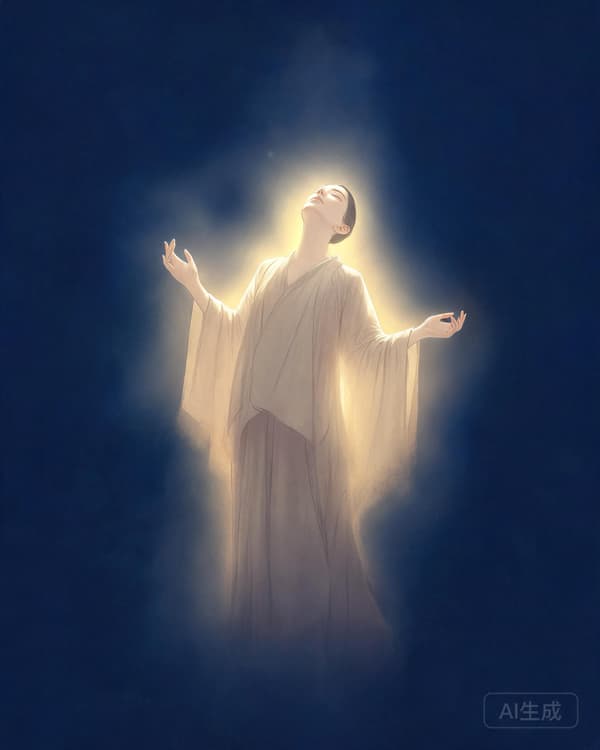
Overview
Origin
From William James's varieties to contemporary epistemology of religious experience
Founded period
Historical tradition
Important figures
See archive records
Major texts
See related archive records
Concept archive
Core Principles
PRINCIPLE 01
The nature of religious experience
PRINCIPLE 02
The argument from religious experience
PRINCIPLE 03
Mysticism and its philosophical interpretation
PRINCIPLE 04
The neurology of experience
PRINCIPLE 05
The epistemic value of experience
Quotation archive
Quote Perspectives
“The world of our experience consists of a visible and an invisible portion... the visible world is part of a more spiritual universe, from which it draws its chief significance; and that union or harmonious relation with that higher universe is our true end.”
“The feeling of it may at times come sweeping like a gentle tide, pervading the mind with a tranquil mood of deepest worship... It may burst from sudden and potent ebullition... It may become the hushed, trembling, and speechless humility of the creature in the presence of — whom or what? In the consideration of this point we already encounter the mysterium tremendum.”
Meaning and Origins
The philosophy of religious experience is the branch of philosophy that asks what religious experience is, whether it can serve as evidence for God's existence, and how it should be interpreted. It sits at the intersection of the philosophy of religion, epistemology, and the psychology of religion. Where the philosophy of God examines arguments from reason, the philosophy of religious experience examines arguments from experience — the claim that direct encounters with the divine can ground belief in a way that abstract proofs cannot.
The modern discipline was effectively created by William James. In The Varieties of Religious Experience (1902), James argued that the "prayer-life" and the "sense of presence" of an unseen order are the practical core of personal religion. He approached religious experience as a pragmatist and a psychologist, cataloging the diverse forms of religious feeling — conversion, saintliness, mysticism — and arguing that the fruits of religious experience (moral transformation, courage, peace) are real and observable, whatever the metaphysical status of the experiences themselves. James was cautious: he didn't claim that religious experience proves God, but he insisted that the total body of experience constitutes a prima facie case that deserves to be taken seriously.
Rudolf Otto gave the philosophy of religious experience its most influential phenomenological account. In The Idea of the Holy (1917), Otto described the experience of the numinous — the "wholly other" that evokes both fascination and dread. The numinous is, for Otto, irreducible: it can't be analyzed into moral feeling or rational cognition but is a category of experience in its own right. His analysis provided the vocabulary that subsequent philosophy of religion would use to describe what it feels like to encounter the divine.
Core Ideas
The Nature of Religious Experience
What counts as a religious experience? The category is broad, encompassing the dramatic (visions, voices, mystical union), the quiet (the sense of presence in prayer), and the moral (the experience of being called to a new life). William James proposed four marks of mystical experience: ineffability (the experience defies expression), noetic quality (it carries the sense of having encountered truth), transiency (it's brief), and passivity (the mystic feels acted upon rather than active). These marks distinguish the mystical from the merely emotional, but they also raise questions: is an experience that can't be put into words really a source of knowledge?
The phenomenology of religious experience is diverse across traditions. Buddhist meditation produces states of absorption and insight that are described in precise technical language. Christian mysticism reports union with God, dark nights of the soul, and the practice of contemplative prayer. Islamic Sufism describes the annihilation of the self in God. Hindu Vedanta reports the identity of the self with Brahman. The question for the philosopher is whether these experiences are all the same phenomenon described differently, or genuinely different experiences that happen to be classified together.
The Argument from Religious Experience
The argument from religious experience, most fully developed by Richard Swinburne, runs as follows. Experiences come in two kinds: public experiences (available to many observers) and private experiences (available to one). For any experience, the principle of credulity says that we should trust it unless there's a reason to doubt. If someone reports seeing a tree, we believe them unless we have reason to think they're mistaken or lying. By the same principle, if someone reports experiencing God, we should believe them unless we have reason to think they're mistaken.
Swinburne argues that the principle of credulity applies to religious experience: the experiential claim "I experienced God" should be trusted unless there's a defeater. The cumulative weight of millions of such experiences, across cultures and centuries, constitutes a strong case for God's existence. The argument is probabilistic rather than deductive: religious experience doesn't prove God, but it makes God's existence more likely than not, given the total evidence.
The argument faces several objections. The principle of credulity, while intuitive, breaks down when the experiences conflict — when Christians report union with a personal God and Buddhists report the dissolution of the self, we can't trust both. The principle of testimony, which says we should trust the reports of others, is also challenged by the disagreement among religious traditions. And the "common factor" objection argues that the common element in religious experiences is not a personal God but a specific psychological state — awe, absorption, ego-dissolution — that is produced by the brain rather than by the divine.
Mysticism and Its Philosophical Interpretation
Mysticism has been the most philosophically productive subfield of the philosophy of religious experience. William James distinguished two types of mystical experience: theistic mysticism, in which the self encounters a divine other, and monistic mysticism, in which the self dissolves into a larger unity. W. T. Stace argued that the "common core" of all mysticism is monistic — the experience of a pure, undifferentiated consciousness — and that theistic interpretations are cultural overlays. Walter Stace's common-core thesis has been challenged by those who argue that theistic and monistic mysticism are genuinely different experiences, not the same experience differently interpreted.
The philosophical question is whether mystical experience can serve as evidence for metaphysical claims. If the mystic reports that all is one, does that count as evidence for monism? Or is it just a report of a psychological state? The debate connects to the philosophy of faith, which asks whether belief can be grounded in experience rather than argument, and to the broader question of what counts as evidence in religious epistemology.
The Neurology of Experience
A contemporary challenge to the epistemic value of religious experience comes from neuroscience. Studies of the brain during meditation and prayer show distinctive patterns of activity, and some researchers have argued that religious experience is entirely explicable in neurological terms. The "God helmet" experiments of Michael Persinger, which purported to induce religious experience by stimulating the temporal lobe with magnetic fields, suggested that the brain can generate the felt presence of the divine without any external cause.
The philosophical question is whether neurological explanation undermines the evidential value of religious experience. The standard response is that every experience has a neural correlate — seeing a tree produces brain activity too — but the presence of the correlate doesn't mean the experience is illusory. The question is whether the neural mechanisms that produce religious experience are more like perception (a response to an external stimulus) or like hallucination (a projection of the brain without an external cause). The debate remains open.
The Epistemic Value of Experience
The deepest question in the philosophy of religious experience is epistemic: does religious experience give us knowledge of God? Alvin Plantinga has argued that the sensus divinitatis — a God-given capacity to perceive the divine — can produce beliefs that are "properly basic," rational without argument. On this view, religious experience is not unlike perception: just as the senses produce beliefs about the external world that are rational without proof, the sensus divinitatis produces beliefs about God that are rational without proof. The claim is that if God exists, we should expect God to make awareness of the divine available through experience, not just through argument. If this is right, then religious experience is not just evidence for God but a source of direct knowledge.
The Philosophy of Religious Experience and the Wider Conversation
The philosophy of religious experience doesn't stand alone. It connects directly to the philosophy of God, which examines the arguments for God's existence from reason — the argument from experience is one more argument, alongside the cosmological, ontological, and teleological. It relates to the philosophy of faith, which asks whether belief can be rational without proof and whether religious experience is a form of evidence. The philosophy of miracles asks whether the divine can break into the natural order, and religious experience is one of the ways that break-in is reported. The philosophy of the sacred explores the quality of experience that Otto called the numinous. The religion, God, and the sacred collection gathers these threads into a complete learning path.
Sources
- Stanford Encyclopedia of Philosophy, "Religious Experience."
- Stanford Encyclopedia of Philosophy, "Religious Epistemology."
- Stanford Encyclopedia of Philosophy, "William James."
- Stanford Encyclopedia of Philosophy, "Philosophy of Religion."
- Stanford Encyclopedia of Philosophy, "Søren Kierkegaard."
Learning Path
Part of a Structured Collection
Religion, God & the Sacred: The Philosophy of Religion Learning Path
A structured learning path through the philosophy of religion: from the philosophy of God and the problem of evil to atheism, faith, religious experience, miracles, prayer, sin, and the sacred.
Continue learning path →
Death & Mortality: The Philosophy of Dying and Meaning
A learning path through the philosophy of death: Epicurus and the Stoics on why death should not frighten us, Heidegger on being-toward-death, and the ethics of dying and grief.
Continue learning path →
Continue Learning
Knowledge NetworkNext Step
Continue your learning path
- collection
Religion, God & the Sacred: The Philosophy of Religion Learning Path
Related through Philosophy Of Religion
- topic
God: The Philosophy of the Divine
Related through Philosophy Of Religion
- topic
Prayer: The Philosophy of Communication with the Divine
Related through Philosophy Of Religion
- topic
The Sacred: The Philosophy of the Holy & Set Apart
Related through Philosophy Of Religion
- philosophy
Philosophy of Faith
Related through Philosophy Of Religion
- philosophy
Philosophy of God
Related through Philosophy Of Religion
- wisdom
God: The Wisdom of the Divine
Related through Philosophy Of Religion
- philosophy
Philosophy of Miracles
Related through Philosophy Of Religion
Archive references
Sources
- 01Religious ExperienceBy Stanford Encyclopedia of PhilosophyConsult source
- 02Religious EpistemologyBy Stanford Encyclopedia of PhilosophyConsult source
- 03William JamesBy Stanford Encyclopedia of PhilosophyConsult source
- 04Philosophy of ReligionBy Stanford Encyclopedia of PhilosophyConsult source
- 05Søren KierkegaardBy Stanford Encyclopedia of PhilosophyConsult source
Source and quality checks completed
Quality check completed 2026-08-21