Overview
Origin
Ancient Greece
Founded period
Ancient world
Important figures
Aristotle · Plato
Major texts
See related archive records
Concept archive
Core Principles
PRINCIPLE 01
Eudaimonia as flourishing
PRINCIPLE 02
Virtue as character trait
PRINCIPLE 03
Doctrine of the mean
PRINCIPLE 04
Practical wisdom (phronesis)
PRINCIPLE 05
Habituation and moral development
Quotation archive
Quote Perspectives
“The human good proves to be activity of soul in accordance with virtue, and if there are several virtues, in accordance with the best and most complete virtue.”
“We become just by doing just actions, temperate by doing temperate actions, courageous by doing courageous actions.”
“The natural law is nothing else than the rational creature's participation of the eternal law.”
“Virtue is a mean between two vices, one of excess and the other of deficiency.”
“Friendship is a virtue or involves virtue, and is besides most necessary for our life.”
“Contemplation is the highest activity of the human soul, and the one that brings the most perfect happiness.”
“We become just by doing just actions, temperate by doing temperate actions, brave by doing brave actions.”
“Virtue is a mean between two vices.”
“No harm can come to a good man, either in life or after death: the gods do not neglect the one who strives to be just.”
“Though our brother is on the rack, as long as we ourselves are at our ease, our senses will never inform us of what he suffers. They never did, and never can, carry us beyond our own person, and it is by the imagination only that we can form any conception of what are his sensations.”
“All men have the mind which cannot bear to see the suffering of others. If men suddenly see a child about to fall into a well, they will all without exception experience a feeling of alarm and distress. And from this we may infer the four beginnings: the feeling of commiseration is the beginning of benevolence; the feeling of shame and dislike is the beginning of righteousness; the feeling of deference and compliance is the beginning of propriety; the feeling of right and wrong is the beginning of wisdom.”
“In the capabilities approach, the central question asked by the political philosopher is not, "How satisfied is this woman?" or "How much in the way of resources is she able to command?" but "What is she actually able to do and to be?"”
“Do not impose on others what you yourself do not desire.”
“From the Son of Heaven down to the common people, all must consider the cultivation of the person the root of all things.”
“A virtue is an acquired human quality the possession and exercise of which tends to enable us to achieve those goods which are internal to practices and the lack of which effectively prevents us from achieving any such goods.”
Virtue Ethics
Origin
Virtue ethics is the oldest of the major traditions in moral philosophy. Its roots lie in ancient Greek thought, above all in the work of Aristotle, though Plato and Socrates prepared the ground by making the condition of the soul and the formation of character central to philosophy. Where later traditions would ask what duty requires or what consequences an action produces, virtue ethics asks what kind of person one should be and how a life is lived well. The Stanford Encyclopedia of Philosophy characterizes virtue ethics as an approach that emphasizes the virtues, or moral character, in contrast to approaches that emphasize duties or rules (deontology) or the consequences of action (consequentialism).
The tradition takes its guiding question from Aristotle's Nicomachean Ethics: what is the highest human good, the end at which all action aims? Aristotle's answer is eudaimonia, a term often translated as happiness but better rendered as flourishing or living well. Eudaimonia is not a passing feeling but the activity of a complete life lived in accordance with reason and virtue. This framing shifts the center of moral inquiry from isolated acts to the whole shape of a life and the dispositions that constitute it.
History
Greek virtue ethics was developed in the fourth century BCE, but its presuppositions reach back to Socrates, who insisted that the unexamined life is not worth living, and to Plato, who organized the virtues of the soul around wisdom, courage, temperance, and justice. Aristotle systematized these inquiries in the Nicomachean Ethics and the Eudemian Ethics, giving the tradition its most influential statement. He located moral virtue in a settled disposition to choose the mean relative to us, as determined by reason and by the person of practical wisdom.
The tradition did not end with antiquity. The Stoics, including Marcus Aurelius, retained the language of virtue while redefining it as the sole unconditional good. Medieval Islamic, Jewish, and Christian philosophers, especially Thomas Aquinas, integrated Aristotelian virtue with theological frameworks, distinguishing natural from infused virtues. Confucian thought, developed independently in China by Confucius and his successors, placed analogous emphasis on the cultivation of character through ritual, study, and the practice of ren (humaneness), a parallel that modern comparative philosophy has explored extensively.
After a long period in which deontology and utilitarianism dominated moral philosophy, virtue ethics was revived in the twentieth century. G. E. M. Anscombe's 1958 essay "Modern Moral Philosophy" argued that duty-based ethics had become incoherent without a shared conception of moral law grounded in a lawgiver, and urged a return to Aristotle's psychology of character and virtue. Alasdair MacIntyre extended this critique in After Virtue (1981), arguing that modern moral discourse had become fragmented because it had lost the telos, the shared conception of the human good, within which the virtues make sense. Philippa Foot and Rosalind Hursthouse further developed neo-Aristotelian virtue ethics into a rigorous contemporary theory.
Core Principles
The first principle of virtue ethics is that the primary subject of moral evaluation is character rather than isolated action. A virtue is a settled disposition, acquired through habituation and informed by reason, to feel, choose, and act well. Courage, generosity, justice, temperance, and honesty are not rules to be followed but traits of a person whose perception, emotion, and deliberation have been properly formed. The Internet Encyclopedia notes that virtue ethics is distinctive in treating the question "what sort of person should I be?" as prior to the question "what should I do?"
The second principle is eudaimonia as the human good. Aristotle identifies the characteristic function (ergon) of human beings with rational activity and argues that eudaimonia consists in activity of the soul in accordance with virtue. This is a teleological framework: the virtues are the traits that enable a human being to flourish, to realize the form of life proper to its kind. The virtues are therefore not arbitrary conventions but grounded in a substantive account of human nature and its fulfillment.
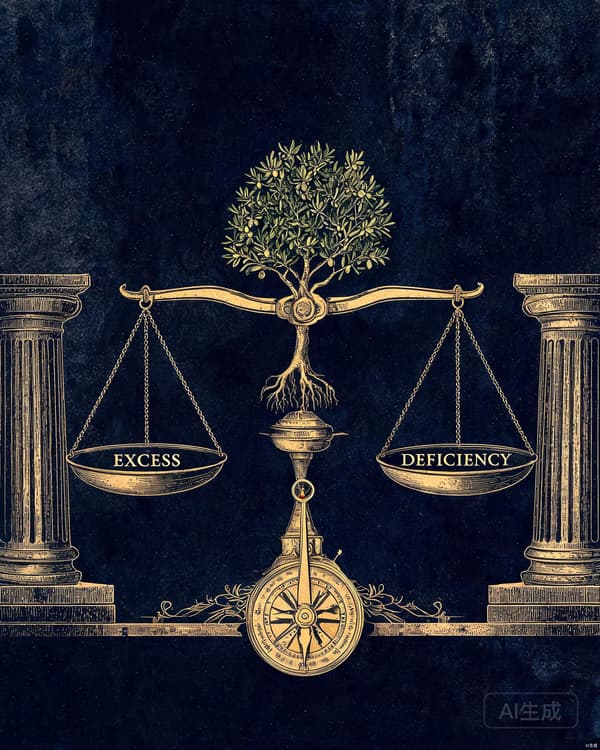
The doctrine of the mean is the third principle, and also the most frequently misunderstood. Aristotle holds that moral virtue is a mean between two vices, one of excess and one of deficiency. Courage is the mean between cowardice and recklessness; generosity between prodigality and miserliness. The mean is not a mathematical midpoint. It is what is appropriate relative to the agent, the object, the circumstances, and the reason for acting, and it is determined by practical wisdom rather than by a formula. A courageous act for a trained soldier and for an unarmed civilian differ in what they require, even though both instantiate the same virtue.
The fourth principle is practical wisdom, or phronesis. The Stanford Encyclopedia describes phronesis as the intellectual virtue that enables one to deliberate well about what is good and advantageous, not in some partial respect but about the good life as a whole. Without practical wisdom, the moral virtues cannot find their mark, because general rules cannot settle what the situation demands. The mean is grasped by perception as much as by calculation, and the person of practical wisdom sees what the particular case requires in a way that no codified procedure can fully replace.
The fifth principle is habituation and moral development. Aristotle insists that we become just by doing just acts, courageous by doing courageous acts, and that virtue is acquired by practice in the same way that craft is acquired. This distinguishes virtue ethics from theories that locate moral life in the application of a rule or the calculation of an outcome. Moral education is not primarily instruction in principles but the formation of dispositions through repeated action, under the guidance of those already possessed of practical wisdom. The emotions are trained as well as the will: the temperate person does not merely resist temptation but has learned to take pleasure in what is fine and to feel aversion to what is base. Habituation does not make virtue mechanical; it makes possible the spontaneous right response that only a settled character can produce. This emphasis on development carries an important implication for the contrast with Kant's deontology, which grounds moral worth in acting from duty rather than from trained inclination, and with utilitarianism, which evaluates acts by consequence rather than by the character they build.
Important Figures
Aristotle is the foundational figure. The Nicomachean Ethics examines happiness, virtue, voluntary action, deliberation, justice, friendship, pleasure, and contemplation, connecting the formation of character to the conditions of a complete human life. Plato supplied the earlier framework of the soul and its virtues, and Socrates supplied the demand that virtue be knowledge and that the life worth living requires examination. The Stoics preserved and transformed the aretaic framework, treating virtue as sufficient for happiness and as the only genuine good.
In the modern revival, Anscombe's intervention reopened the question of whether morality could dispense with a conception of human flourishing. MacIntyre argued that the virtues are intelligible only within practices, traditions, and narratives that supply the telos of a human life, and that the Enlightenment's attempt to found morality on universal reason alone had failed. Foot, in Natural Goodness (2001), sought to ground ethical evaluation in the natural norms of human life, while Hursthouse developed a full account of right action in terms of what the virtuous agent would do. Confucius provides the most significant non-Greek parallel, organizing ethical life around the cultivation of exemplary character through ritual, learning, and the practice of humaneness.
Modern Influence
Virtue ethics now stands alongside deontology and consequentialism as one of the three principal approaches in moral philosophy. Its influence extends into professional ethics, where the formation of character and professional judgment has complemented rule-based codes; into education, where the cultivation of virtue has reentered debate about moral development; and into positive psychology, which has drawn on Aristotelian themes of flourishing and the good life. The capabilities approach of Martha Nussbaum, which draws explicitly on Aristotle, has shaped international development policy and the measurement of human well-being.
The tradition has also reshaped comparative philosophy. The parallels between Aristotelian virtue and Confucian self-cultivation have generated a substantial literature on whether the two traditions converge or merely resemble one another. In political theory, MacIntyre's communitarian critique of liberalism, grounded in the claim that the virtues require shared practices and traditions, has reframed debates about the moral resources of modern societies.
Criticism
Virtue ethics faces several objections. The first concerns guidance: critics charge that an ethics centered on character and perception offers insufficient action-guidance, since it tells us to do what the virtuous person would do without specifying what that is in determinate cases. Defenders reply that this reflects the nature of moral life, where no rule can fully anticipate circumstance, and that practical wisdom is precisely the capacity to perceive what is required. A second objection targets relativism: if the virtues are intelligible only within particular traditions, as MacIntyre argues, then virtue ethics may lack the resources to adjudicate conflict between traditions or to criticize oppressive social forms. A third objection concerns the teleological foundation: if eudaimonia depends on a substantive account of human nature, then the theory may inherit controversial or outdated assumptions, including Aristotle's own defenses of hierarchy and slavery. Contemporary virtue ethicists have worked to detach the insights about character and flourishing from these inheritances, but the difficulty of grounding the virtues without a contested anthropology remains a live problem.
Sources
- Stanford Encyclopedia of Philosophy, "Virtue Ethics." Comprehensive survey of the tradition, the modern revival, and its main variants and criticisms.
- Stanford Encyclopedia of Philosophy, "Aristotle's Ethics." Detailed treatment of eudaimonia, the doctrine of the mean, and practical wisdom in the Nicomachean Ethics.
- Internet Encyclopedia of Philosophy, "Virtue Theory." Accessible account of virtue ethics and its comparison with deontology and consequentialism.
Learning Path
Part of a Structured Collection
Ethics & Moral Wisdom
A structured learning path through moral philosophy, from the great ethical theories of duty, utility, and virtue to the practical art of making ethical decisions in everyday life.
Continue learning path →
Understanding Reality
A learning path through truth, knowledge, reality, and perception — from Plato to existential philosophy.
Continue learning path →
Understanding Yourself
A learning path through self-knowledge, identity, wisdom, and practical discernment — from Socrates to modern philosophy.
Continue learning path →
Ancient Wisdom
A learning path through foundational questions of flourishing, virtue, harmony, duty, and the art of living.
Continue learning path →
Continue Learning
Knowledge NetworkNext Step
Continue your learning path
- answer
What Is Virtue Ethics? Character, Flourishing & Moral Philosophy
Related through Virtue
- answer
How Is Moral Character Formed and Developed?
Related through Virtue
- answer
How to Make Good Decisions?
Related through Virtue
- wisdom
Virtue
Related through Ethics
- quote
MacIntyre: Virtue, Practice, and Internal Goods
Related through Virtue
- answer
Aristotle vs Kant: Virtue Ethics vs Duty Philosophy
Related through Virtue
- answer
Exploring Virtue Ethics
Related through Ethics
- answer
How Do I Build Character?
Related through Virtue
Archive references
Sources
- 01Virtue EthicsBy Stanford Encyclopedia of PhilosophyConsult source
- 02Aristotle's EthicsBy Stanford Encyclopedia of PhilosophyConsult source
- 03Virtue TheoryBy Internet Encyclopedia of PhilosophyConsult source
Source and quality checks completed
Quality check completed 2026-07-31