Archive navigation
Knowledge Path
Quotation archive
Selected Quotes
“All phenomena are preceded by the mind. The mind is their master; they are produced by the mind. If one speaks or acts with a corrupted mind, suffering follows, as the wheel of the cart follows the ox's hoof.”
“Hatred is never appeased by hatred in this world. By non-hatred alone is hatred appeased. This is an ancient law.”
“There is no fire like passion. There is no grip like anger. There is no net like delusion. There is no river like craving.”
“As rain leaks into an ill-thatched house, so passion enters an uncultivated mind. As rain does not leak into a well-thatched house, so passion does not enter a cultivated mind.”
“You yourselves must make the effort. The Buddhas are only teachers. Those who enter this path and practice meditation are freed from Mara's bonds.”
“Just as a mother would protect her only child with her life even so let one cultivate a boundless love towards all beings.”
“All conditioned things are impermanent — when one sees this with wisdom, one turns away from suffering. This is the path to purification.”
“Happily we live, we who possess nothing; feeders on joy shall we be, like the radiant gods.”
“Our happiness does not stand alone, nor does it come from being alone. It is inextricably linked with the happiness of others.”
“Therefore, Ananda, be a lamp unto yourselves, be a refuge unto yourselves; take no other refuge. Hold to the Dhamma as a lamp, hold to the Dhamma as a refuge.”
“All conditioned dharmas are like a dream, an illusion, a bubble, a shadow, like dew, like a flash of lightning — and should be viewed as such.”
“Form is emptiness, emptiness is form. Form is no other than emptiness, emptiness is no other than form. The same is true of feelings, perceptions, mental formations, and consciousness.”
“The rain from a single cloud falls in a single stream, yet each plant and tree, each herb and shrub, receives its own measure of water and grows.”
“No man is devoid of a heart sensitive to the suffering of others. Such a heart is the origin of humaneness.”
Biography
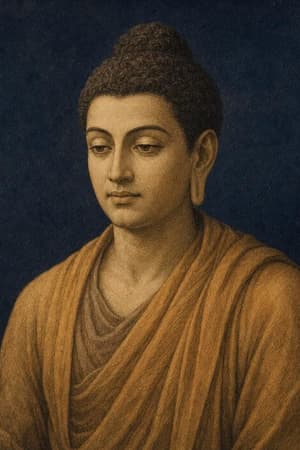
Buddhist traditions identify the Buddha as Siddhartha Gautama, a teacher who lived in ancient northern India and attained awakening. Dates for his life remain debated, and the earliest biographies were compiled from oral and textual traditions rather than contemporary historical records. For that reason, a responsible account distinguishes what traditions affirm from what modern historians can securely reconstruct.
Historical Context
The Buddha is situated in a period of urban growth, political change, and religious experimentation in the Ganges region. Renunciant communities debated karma, rebirth, knowledge, ascetic discipline, and release from repeated suffering. The early Buddhist community formed within this wider intellectual landscape.
Core Ideas
Teachings attributed to the Buddha include the Four Noble Truths, the Eightfold Path, impermanence, dependent arising, ethical restraint, meditation, and liberation. They are practices of inquiry and cultivation rather than a single abstract doctrine detached from conduct.
Philosophy
Buddhist philosophy investigates how suffering arises through conditions, habits, and grasping, and how wisdom and ethical practice can transform those conditions. Later Buddhist traditions developed distinct accounts of selfhood, emptiness, knowledge, and compassion. The Buddha should therefore be read as the source of a diverse historical tradition, not as a spokesperson for every later Buddhist claim.
Major Works
No book can be securely treated as an autograph work by the Buddha. Teachings are preserved in early collections such as the Pali Nikāyas and parallel Āgamas. The Dhammapada, a canonical collection of verses, is a useful entry point when read in a named translation and alongside its literary context.
Influence Today
The Buddha's teachings have influenced religious institutions, philosophical inquiry, ethical reflection, art, and meditation traditions throughout Asia and globally. Modern adaptations should be evaluated carefully, with attention to their relationship to Buddhist communities and texts.
Sources
See the source records above. This page avoids assigning isolated internet quotations to the Buddha without a traceable canonical location and translation.
Learning Path
Part of a Structured Collection
Mindfulness & Meditation
A curated learning path through mindfulness and meditation, tracing the practices from their Buddhist philosophical origins to modern clinical applications. Explore foundational teachings, key thinkers, comparative analyses, and evidence-based techniques for cultivating present-moment awareness.
Continue learning path →
Eastern Philosophy
A guided learning journey through Eastern philosophical traditions, including Buddhism, Confucianism, Taoism, and Zen, and the wisdom that unites them.
Continue learning path →
Understanding Yourself
A learning path through self-knowledge, identity, wisdom, and practical discernment — from Socrates to modern philosophy.
Continue learning path →
Buddhist Wisdom
A guided learning journey through Buddhist philosophy, compassion, the Buddha, and the Dhammapada.
Continue learning path →
Continue Learning
Knowledge NetworkNext Step
Continue your learning path
- book
Dhammapada
Related through Buddhism
- philosophy
Buddhism
Related through Compassion
- wisdom
Forgiveness
Related through Buddhism
- answer
How to Practice Meditation?
Related through Buddhism
- answer
How to Practice Metta (Loving-Kindness)?
Related through Buddhism
- topic
Meditation
Related through Buddhism
- wisdom
Mindfulness
Related through Buddhism
- topic
Mindfulness
Related through Buddhism
Archive references
Sources
- 01BuddhismBy Stanford Encyclopedia of PhilosophyConsult source
- 02The BuddhaBy Rupert GethinOxford: Oxford University Press, 2001.
- 03The DhammapadaBy translated by Gil FronsdalBoston: Shambhala, 2005.
Source and quality checks completed
Quality check completed 2026-07-22